
People often ask why women stay in abusive relationships or situations.
But maybe we’ve been focusing on the wrong question.
Maybe the better questions are:
What happens to a woman’s nervous system when fear becomes part of her everyday life—especially when her children are part of the equation?
And:
What was happening around her—and inside her—that made leaving feel impossible, unsafe, or even more dangerous than staying?
Because knowing you need to leave and being able to leave are two very different things.
When the person hurting you is also the father of your children, when your finances are tied together, when your kids are sleeping down the hall, when you don’t know where you would go or how you would pay for it, the question often stops being:
Is this fair to me?
And becomes:
How do I keep everybody safe?
How do I keep a roof over my children’s heads?
How do I keep their world steady?
What happens if I leave and he gets worse?
What happens with custody?
What happens if I can’t afford daycare?
What happens if nobody believes me?
What happens tomorrow?
Sometimes, whether it makes sense to an outsider or not, staying still feels safer than blowing everything up.
And before we judge a woman for that, we need to understand what survival can actually look like.
Your Body Doesn’t Always Choose Fight or Flight
We hear about “fight or flight” so often that it can sound as though those are our only two responses to danger.
Fight back.
Or run.
But the human threat response is more complicated than that. Freezing is also a recognized defensive response to threat.

And that matters.
Because if you’ve ever looked back at something that happened to you and thought:
Why didn’t I do something?
Why couldn’t I move?
Why did I just stand there?
Why did I shut down?
Why did I focus on keeping him calm instead of standing up for myself?
Why couldn’t I think clearly?
I need you to understand something.
Not every response your body produces in danger is a carefully considered decision.
When the brain perceives threat, systems designed to help us survive begin responding. In a healthy situation, the danger eventually passes and the body can come back down.
But what happens when the threat lives in your house?
What happens when you don’t know whether tonight will be peaceful or explosive?
What happens when you’ve learned to study someone’s voice, facial expressions, footsteps or mood because those tiny changes might tell you what kind of night you’re about to have?
You adapt.
You may become hyperaware of danger. You may find yourself constantly anticipating what could happen next. Trauma and chronic threat can affect attention, memory, emotional regulation and the body’s stress-response systems.
That does not mean you are incapable of making decisions.
It means we need to stop judging survival behavior as though every decision was made by someone sitting safely, calmly and objectively outside of the danger.
And if you’re reading this because you’ve spent months—or years—asking yourself what the hell is wrong with you:
Maybe that’s another question worth exploring.
Maybe instead of asking,
“What is wrong with me?”
we start with:
“What happened to me, and what did I have to learn to do to survive it?”
Understanding that does not take away your ability to choose what happens next.
It gives you context.
And context can take some of the shame out of survival.
Sometimes She Isn’t Choosing Him. She’s Choosing Between Bad Options.
This is one of the biggest things missing from conversations about women who stay.
People talk about leaving as though the decision is:
Abusive relationship OR happy new life.
That’s rarely the actual choice sitting in front of her.
Her choices might look more like:
Stay where I know what I’m dealing with—or leave without enough money for rent.
Stay—or risk losing childcare.
Stay—or move my children into instability.
Stay—or risk a custody battle with the person I’m afraid of.
Stay—or lose access to transportation.
Stay—or leave the health insurance I depend on.
Stay—or go somewhere he might find me.
Stay—or tell people what has really been happening and hope they believe me.
Those aren’t easy choices.
They’re survival calculations.
The National Domestic Violence Hotline identifies numerous barriers that can make leaving extraordinarily difficult: fear of retaliation, children, custody concerns, emotional attachment, financial despair, homelessness, isolation, lack of transportation, lack of support, promises of change, shame and simply having nowhere safe to go.
Sometimes a woman stays because she loves him.
Sometimes she stays because she’s terrified of him.
Sometimes she stays because she believes he’ll change.
Sometimes she stays because she doesn’t have $20 to herself.
Sometimes she stays because she knows exactly what he’s capable of if she tries to leave.
And this is where so much of the confusion comes in: all of those things can be true at the same time.
Human beings are complicated.
Abuse doesn’t suddenly make us less so.
And Then There Are the Children
Children change the equation.
From the outside, people may think:
She should leave for her kids.
Meanwhile, she may be lying awake thinking:
Where will my kids sleep if I leave?
Can I afford food?
Who will watch them while I work?
What happens if he fights me for custody?
What if they have to be alone with him and I’m not there to protect them?
What if leaving destroys the only stability they have?
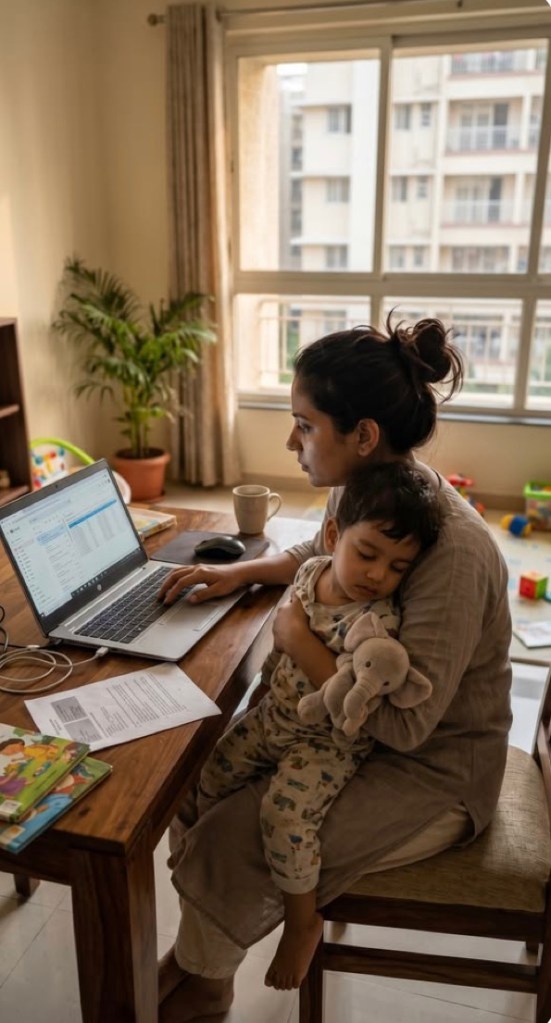
None of those questions automatically mean staying is safer for the children.
But they do explain why “just leave” is not a plan.
A mother can desperately want something different for herself and her children while also being terrified of what getting there will require.
And sometimes keeping the peace becomes its own survival strategy.
You learn what sets him off.
You learn when to stop talking.
You learn when to agree.
You learn how to redirect.
You learn how to make everything look normal for the kids.
You learn how to carry fear quietly.
From the outside, that can look like staying.
From inside the house, it may feel like managing danger.
Money Can Become a Cage Without Bars
Then there’s the financial piece.
Financial abuse is not just someone being “controlling about money.”
It can mean preventing a partner from working, sabotaging her employment, controlling access to bank accounts, withholding money for necessities, damaging her credit, creating debt in her name, stealing assets or refusing financial support.
The National Network to End Domestic Violence reports that financial abuse occurs in 99% of domestic violence cases.
Think about what that means when someone tells a woman:
“Just leave.”
Leave with what?
A woman may know perfectly well that something is wrong while simultaneously having no independent income, damaged credit, no accessible savings, no affordable childcare and nowhere she can immediately take her children.
And here’s something that doesn’t get talked about nearly enough: financial abuse doesn’t necessarily end when the relationship does.
An abusive partner can continue using money as a means of control after separation—through withheld child support, shared debts or assets, legal expenses and other forms of financial manipulation.
Leaving the relationship doesn’t magically repair destroyed credit, erase coerced debt, create affordable housing, secure childcare, replace lost income or guarantee that an abusive former partner will suddenly cooperate financially.
Physical distance can end one form of access while other methods of control continue.
That’s why financial independence isn’t some shallow side issue in conversations about abuse.
Money can be part of safety.
Leaving Isn’t Always the Moment the Danger Ends
This is another reason I hate how casually people say, “Why didn’t she just leave?”
Because leaving isn’t necessarily the finish line.
For some survivors, separation can be a period of heightened danger.
An abusive partner who has relied on control may escalate when that control is threatened. Research on separation from abusive partners describes leaving as a complex, nonlinear process in which survivors often assess risk, anticipate an abuser’s reaction and make safety calculations about when and how to separate.
And that shifts our focus to another question.
Instead of:
“Why didn’t she leave?”
Maybe we ask:
“What would she need to leave as safely as possible?”
Those are completely different conversations.
One assigns blame.
The other creates options.
And options are exactly what abuse works so hard to take away.
If You’re Reading This and You’re Still There
This part is for you.
Not the people analyzing your relationship.
Not the people wondering why you haven’t left.
Not the people who think they know exactly what they’d do if they were you.
You.

If you know something isn’t right but you’re not ready to leave, that doesn’t mean you have to pretend it’s okay.
If you’ve left before and gone back, that doesn’t erase the fact that you tried.
If you still love the person hurting you, that doesn’t mean the hurt isn’t real.
If part of you wants out while another part is terrified of what happens afterward, both things can exist at once.
And if your body has responded to fear in ways you don’t understand—freezing, shutting down, becoming hyperalert, trying desperately to keep the peace—you don’t have to turn those responses into evidence against yourself.
Understanding survival isn’t the same thing as surrendering your future to it.
You can understand why something happened and still decide you want something different.
You can acknowledge that leaving may be complicated and still begin creating options.
You can prepare before you’re ready.
You can gather information.
You can talk privately with an advocate.
You can learn what resources exist where you live.
You can start thinking about financial safety.
You can make a safety plan.
You can tell one safe person.
You can begin rebuilding trust in your own judgment.
You do not have to solve your entire life tonight.
And you don’t have to shame yourself into safety.
Safety Planning Is Still Progress
One of the most important things I learned while researching this article is that safety planning isn’t reserved for the day someone finally leaves.
A safety plan can help while someone is still experiencing abuse, while preparing to leave and after separation.
That distinction matters.
Because sometimes the next safest step isn’t packing a bag tonight.
Sometimes it’s learning.
Documenting.
Protecting important information.
Understanding your finances.
Finding out where you could go.
Talking confidentially with an advocate.
Learning your legal options.
Identifying someone you trust.
Thinking through what you would do during an emergency.
Creating choices where there weren’t choices before.
There is no single safety plan that works for every survivor. Circumstances involving children, finances, housing, technology, weapons, stalking, custody, disability, immigration status and countless other factors can completely change what is safe.
That’s why individualized safety planning matters.
Where to Start
If you are experiencing domestic violence or questioning whether what you’re experiencing is abuse, you do not have to wait until you’ve decided to leave before asking for information.
The National Domestic Violence Hotline provides confidential support and safety-planning assistance and can help connect survivors with resources available in their area.
Call: 1-800-799-SAFE (7233)
Text: START to 88788
Local domestic violence programs and Family Justice Centers may also provide or connect survivors with services such as emergency shelter, advocacy, transportation assistance, legal support, financial assistance and other resources. Availability varies significantly by location.
Local legal-aid organizations may be able to help survivors understand options involving protective orders, custody, housing, financial issues and other legal concerns. Laws and available protections vary by state, so individualized legal advice matters.
Economic-justice and survivor-support organizations may also be able to help with credit, coerced debt, employment, financial planning and rebuilding financial independence.
And if you’re researching any of this from a device your partner may monitor, consider your digital safety as part of your safety plan.
You don’t have to use every resource.
You don’t even have to know exactly what you want yet.
Sometimes the first step is simply finding out what your options are.
Maybe We’ve Been Asking the Wrong Question All Along
“Why did she stay?”
It’s such a small question for something this complicated.
It reduces children, money, housing, fear, trauma, love, coercion, threats, safety, hope, isolation and survival down to one woman’s decision.
And then asks her to defend it.
Maybe she has done enough defending.
Maybe instead of asking why she stayed, we should ask:
What made leaving feel impossible?
What made staying feel safer?
What was taken away from her that she would need in order to have real choices?
What support would make her safer now?
And if you’re the woman asking the question about yourself—
Why am I still here?
Maybe you don’t need another voice criticizing you.
Maybe you need information.
Maybe you need support.
Maybe you need resources.
Maybe you need time to build a safer path forward.
Maybe you need to understand that some of the things you’ve hated yourself for were your mind and body trying to get you through something they perceived as dangerous.
None of that means you have to stay forever.
It means your story deserves more compassion and more complexity than:
“Why didn’t you just leave?”
So maybe the question for today isn’t:
Why am I still here?
Maybe it’s:
What do I need to become safer, more supported, and more able to choose what comes next?
And wherever you are in that process—
you are still becoming.





Leave a Reply