
I didn’t feel like myself all week. Then my period started—and everything changed. That experience led me to learn about PMDD, PME, ADHD, and why I started tracking my symptoms instead of guessing.
For several days, I couldn’t figure out what was wrong with me.
I couldn’t focus. I wasn’t getting things done the way I normally could. I was struggling to execute tasks, my motivation felt off, I was getting overstimulated easily, and I was irritable and short-tempered.
Somewhere in the middle of that week, it finally clicked:
I don’t feel like myself.
My first thought was my ADHD medication.
I started wondering whether it had stopped working the way it was supposed to. Maybe my dose wasn’t enough anymore. Maybe something had changed.
But even that didn’t completely make sense to me.
My medication had already been increased only a few months earlier, so I was hesitant to believe that it had suddenly stopped working this dramatically for no apparent reason. And to be honest, because of some of the same recurring symptoms I was experiencing, I also knew I was probably about to start my cycle soon.
And that’s when I remembered a TikTok I had seen from a friend about a week earlier.
She had talked about her own experience after having children back-to-back—something I could immediately relate to.
When you spend years pregnant, postpartum, pregnant again, caring for babies, and simply trying to keep everybody alive and functioning, there isn’t always much opportunity to stop and ask:
What is my body actually doing?
Now that she finally wasn’t having babies back-to-back, she had been able to pay closer attention to her body, talk with her doctors, and start figuring out some of the things she had been experiencing.
One of the things she talked about was PMDD—premenstrual dysphoric disorder.
When I originally saw her video, I didn’t immediately think, Oh my God, that’s me.
I watched it, took the information in, and kept moving.
But now, days later, I was sitting there unable to focus, struggling to complete things I normally could, and feeling noticeably different from my usual ADHD baseline.
And then it hit me.
That video.
So I started researching.
That’s when I learned more about PMDD.
And then I learned about something I had never even heard of before:
PME—premenstrual exacerbation.
That one immediately caught my attention because I already have ADHD.
So instead of asking only, Could I have PMDD? I now had another question:
Could my ADHD itself be getting worse at a certain point in my menstrual cycle?
And that brought me right back to the medication question.
What if my medication hadn’t suddenly stopped working?
What if something else was temporarily making my ADHD symptoms significantly harder to manage?
I still wasn’t ready to say I had PMDD, PME, or anything else. I had only just started researching it.
But while thinking through what I had been experiencing, I remember thinking:
I bet I’m about to start my period.
So instead of trying to decide what was happening based on one difficult week, I waited.
And I paid attention.
Then my period started.
And later that same day, something happened that made me pay even closer attention:
I felt like myself again.
My focus came back.
I could execute tasks again.
My brain felt clearer.
I felt functional.
I felt like I had returned to my normal baseline.
And as I’m writing this, I’m only a few days into my period—but that baseline has stayed.
That does not tell me that I definitely have PMDD.
It doesn’t tell me that I definitely have PME.
And it certainly doesn’t tell me whether I could ultimately be dealing with one, the other, both, or something else entirely.
But it did tell me something important:
There was a pattern here worth documenting.
And the more I researched, the more I realized that tracking the pattern isn’t just helpful—it’s an important part of how healthcare providers evaluate what may actually be happening.
Because the question isn’t simply:
“How bad do I feel before my period?”
The bigger question is:
What happens to those symptoms before, during, and after my period—and what do I feel like during the rest of my cycle?
That’s where this whole thing became much more interesting.
And honestly, it made me wonder how many other women have spent days every month thinking:
My medication isn’t working.
Why can’t I get anything done?
Why is everybody getting on my nerves?
Why am I so overstimulated?
Why do I suddenly feel like I can’t manage things I normally manage?
—or simply—
Why don’t I feel like myself?
without ever realizing that when those symptoms happen might be just as important as the symptoms themselves.
These are the notes I started writing as I researched and tried to make sense of what I was experiencing.

PMDD vs. PME: What’s the Difference?
This was the next thing I had to understand, because at first, PMDD and PME sounded almost identical.
And honestly? During the week before your period, they can look very similar.
Both can involve changes in mood, irritability, anxiety, difficulty concentrating, low energy, sleep or appetite changes, physical symptoms, and feeling like your ability to function has suddenly taken a hit.
The difference isn’t necessarily obvious when you’re right in the middle of the bad days.
The difference starts showing up when you look at the entire cycle.
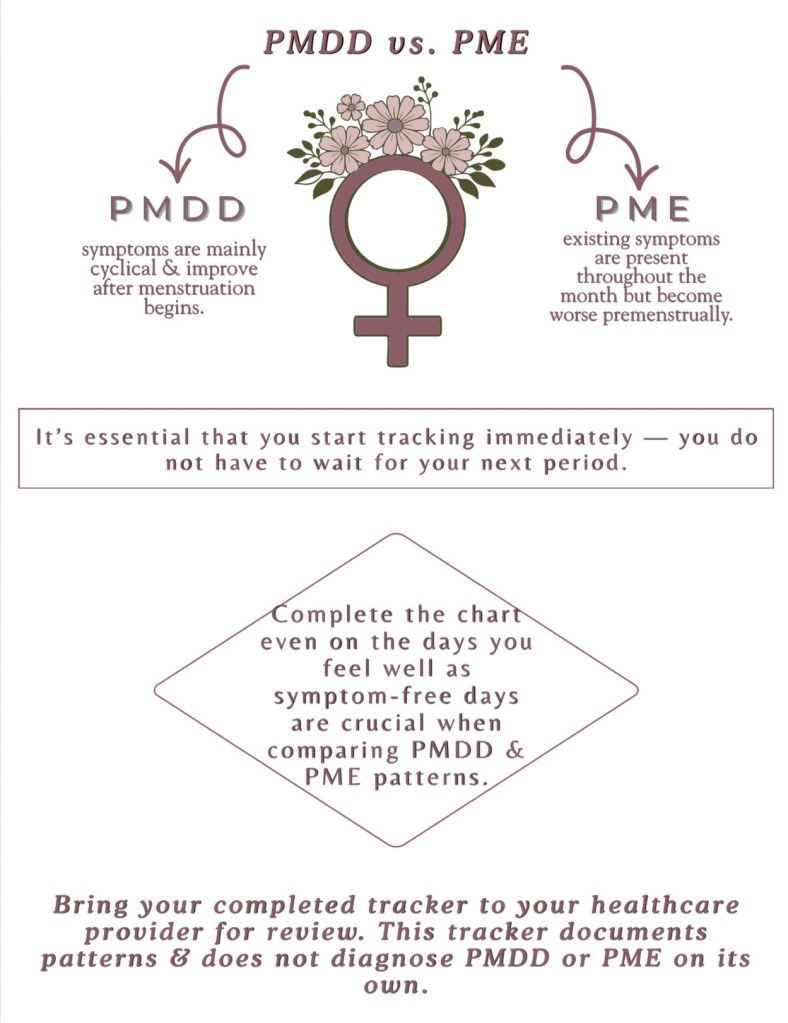
PMDD
PMDD stands for Premenstrual Dysphoric Disorder.
With PMDD, symptoms follow a cyclical pattern. Diagnostic criteria describe symptoms becoming significant during the final week before menstruation, beginning to improve within a few days after menstruation starts, and becoming minimal or absent during the week afterward. PMDD symptoms must also cause significant distress or interfere with areas such as work, school, relationships, social activities, or everyday functioning. Prospective daily symptom ratings across at least two symptomatic cycles are used to confirm the pattern.
In other words, there is more of an “on/off” pattern.
There is a period when symptoms become significant, followed by a period when you return much closer to your normal baseline.
PME
PME stands for Premenstrual Exacerbation.
This is different because the symptoms belong to an existing condition that is already there.
With PME, symptoms of an underlying condition are present throughout the cycle but become noticeably worse during the premenstrual portion of it. Afterward, they move back toward that person’s usual baseline rather than disappearing altogether. Prospective tracking across cycles can help distinguish that pattern from PMDD and from symptoms that aren’t actually cycle-related.
And that distinction immediately mattered to me because I already have ADHD.
I am not trying to figure out whether I suddenly developed trouble concentrating out of nowhere.
Difficulty with focus and executive functioning already exists in my baseline.
What I need to know is whether those symptoms become significantly worse at a predictable point in my cycle.
That is a very different question.
Research into menstrual-cycle-related changes in ADHD is still developing, so I don’t want to present the connection as more settled than it is. But emerging research has reported cycle-related worsening of attention, executive functioning, emotional regulation, and perceived medication effectiveness in some people with ADHD. The evidence is promising, but studies are still relatively limited and use varying methods.
That was enough for me to think:
This is worth paying attention to.
And Yes—It Can Be More Complicated Than One or the Other
This was another thing I didn’t initially understand.
A person may have an existing condition that worsens premenstrually while also experiencing other cyclical symptoms that need to be evaluated separately.
That is one reason trying to determine what is happening based on memory alone can get confusing very quickly.
Premenstrual disorders and underlying conditions can overlap, and prospective tracking gives a healthcare provider much more information to work with than trying to remember everything after the fact.
And that brings me to probably the most important thing I learned while researching all of this:
The Bad Week Isn’t the Only Week That Matters
Before researching PMDD and PME, I would have assumed that if you were trying to figure out whether your symptoms were connected to your cycle, you would document the days when you felt bad.
That actually misses a huge part of the picture.
You also need to document the days when you feel fine.
Because if I write down that my concentration was terrible, I was irritable, overstimulated, and exhausted for five days, that tells my provider what happened.
But it doesn’t tell them whether:
those symptoms disappeared afterward,
they returned to my normal ADHD baseline,
they stayed just as severe,
they appeared again at the same point during the next cycle,
or they had absolutely nothing to do with my menstrual cycle in the first place.
The comparison is the information.
That is why prospective daily symptom tracking across at least two symptomatic menstrual cycles is part of formal PMDD evaluation. The Daily Record of Severity of Problems, or DRSP, is one validated tool designed to measure PMDD symptoms and impairment.
And suddenly all of the tracking made sense to me.
They aren’t only looking for:
“Did you feel terrible before your period?”
They’re looking for:
When did the symptoms start?
How severe did they become?
What happened once menstruation started?
What happened during the days afterward?
Did you return to your normal baseline?
Were certain symptoms present throughout the month but dramatically worse before your period?
And then:
Did the same pattern happen again?
That is an entirely different level of information than walking into an appointment weeks later and trying to remember exactly how you felt.
Wait—What Exactly Is the Luteal Phase?
Here was my next problem.
I kept reading phrases like “luteal phase,” “follicular phase,” and “after ovulation” as if everybody was just walking around knowing exactly which phase of their menstrual cycle they were in.
I was not.
And if you don’t understand what those phases mean, being told to watch for symptoms during a particular phase isn’t especially helpful.
The easiest way I found to understand it is this:
Your period begins → follicular phase → ovulation → luteal phase → your next period begins.
The follicular phase begins on the first day of menstruation and continues until ovulation.
Ovulation is when an egg is released.
The luteal phase begins after ovulation and ends when the next period begins.
That makes the days leading up to menstruation part of the luteal phase—the time period that becomes especially important when looking for premenstrual symptom patterns.
And here’s something I think is important:
You do not need to know exactly when you ovulate before you start paying attention.
I certainly didn’t.
You can start with what you do know:
What day is it?
Am I bleeding or spotting?
How do I feel today?
How severe are my symptoms?
Then you keep going.
Day after day.
Including the boring days.
Including the good days.
Including the days when you feel completely like yourself.
Because those may end up being some of the most important days on the entire chart.
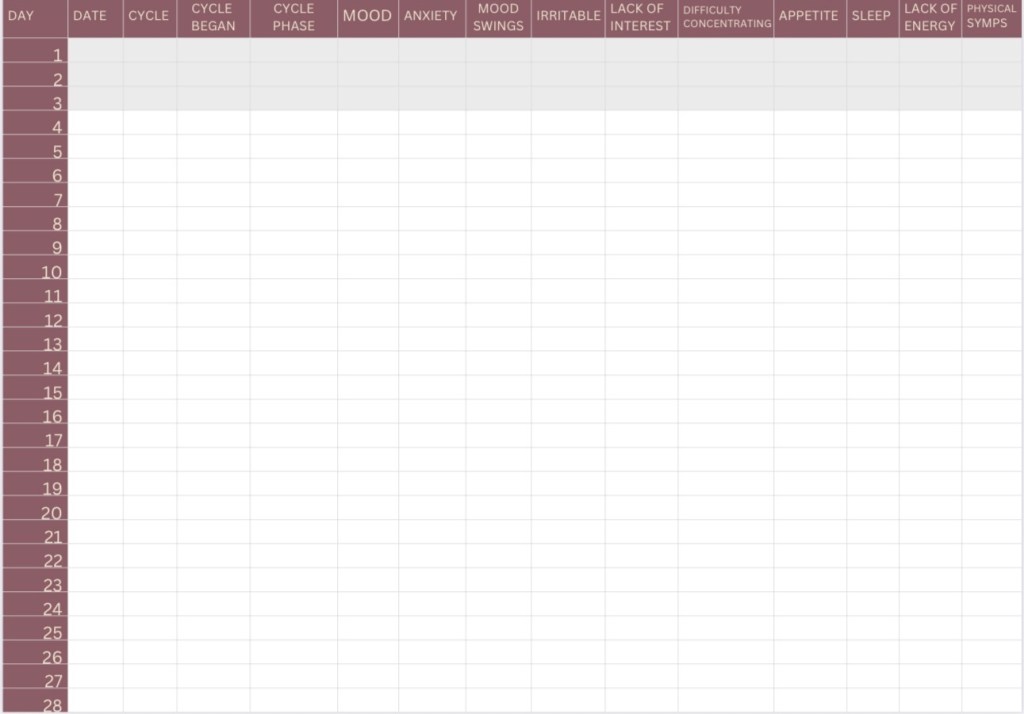
The tracker I created records symptoms every day rather than only during the days I feel bad, so I can compare changes across the entire cycle.
What I Decided to Track
Once I understood why the entire cycle mattered, I wanted something I could realistically complete every day without writing a journal entry every night.
So I created an 84-day tracking system that gives me plenty of continuous space to work toward documenting at least two full menstrual cycles.
If two complete cycles aren’t captured by Day 84, tracking can simply continue.
I included the symptoms that repeatedly appeared in PMDD symptom-tracking resources:
Mood. Anxiety. Mood swings. Irritability. Lack of interest. Difficulty concentrating. Appetite changes. Sleep changes. Low energy. Physical symptoms.
I also included menstrual-cycle information so I can see exactly where those symptoms fall in relation to bleeding and cycle phase.
And because my existing condition is ADHD, I’m also paying attention to something that matters specifically in my situation:
What is happening compared with my normal baseline?
That distinction matters.
I already know what ADHD feels like for me.
What caught my attention was realizing:
This doesn’t feel like my normal ADHD.
And that is exactly the kind of difference I want documented before I sit in front of a healthcare provider trying to explain it from memory.
Okay, I Tracked It. Now What Am I Looking For?
This is the part where daily numbers start turning into an actual pattern.
When I first started putting this together, I assumed the important part would be documenting how severe each symptom became.
But severity is only one piece of it.
What matters just as much is timing, change, and what happens afterward.
If my irritability is a 3 one day, that tells me I had a rough day.
But if my irritability, overstimulation, trouble concentrating, and low energy all begin climbing during the same part of my cycle, then improve after menstruation begins—and that happens again during the next cycle—that tells a much more useful story.
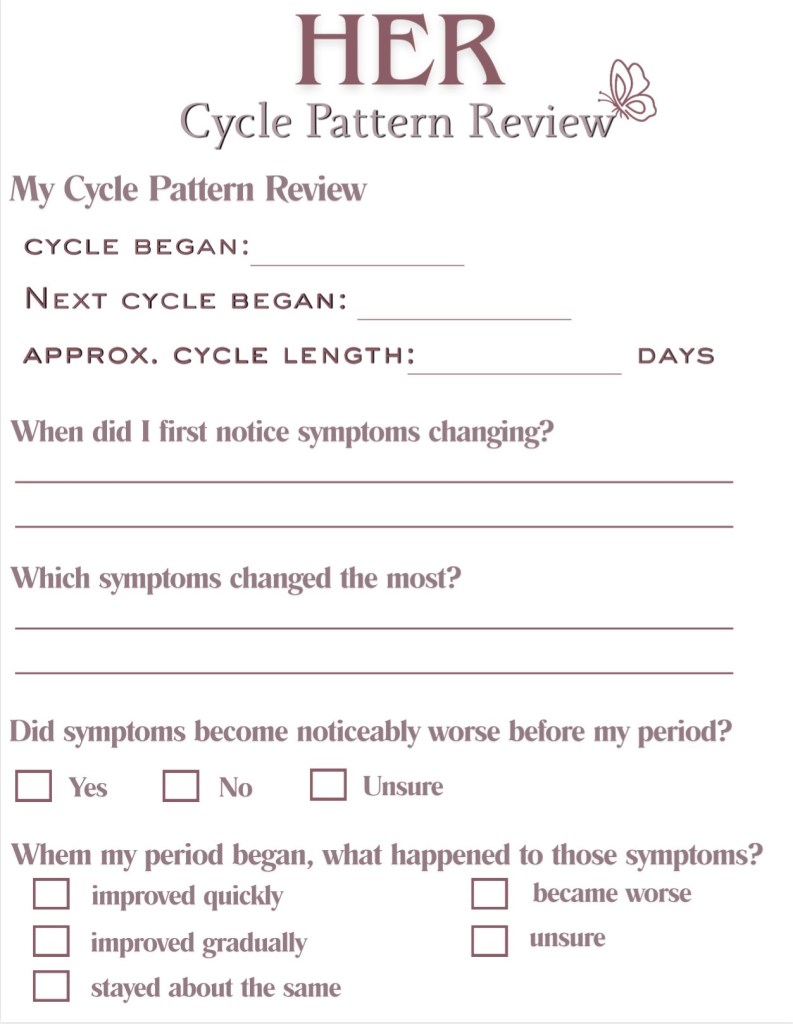
That is why I added a Cycle Pattern Review after the daily tracking pages.
The review forces me to step back and look at the whole picture instead of getting stuck on individual bad days.
The Questions I’m Actually Trying to Answer
After each cycle, I want to be able to look back and ask:
When did I first notice my symptoms changing?
Which symptoms changed the most?
Did they become noticeably worse before menstruation?
What happened once my period began?
Did symptoms improve quickly, gradually, stay the same, or get worse?
During the days afterward, did any symptoms become minimal or disappear?
Which symptoms stayed at my usual baseline?
Did my existing ADHD symptoms become noticeably harder to manage?
Did my medication seem less effective during any particular part of my cycle?
Most importantly, did any of this interfere with my ability to function?
That last part matters more than I initially realized.
PMDD is not defined only by having uncomfortable symptoms before menstruation. Clinical criteria also consider whether symptoms cause significant distress or interfere with work, school, relationships, social activities, or everyday functioning.
And that made me think differently about my own week.
I wasn’t simply thinking:
I was irritable.
I was thinking:
Was I so irritable that it changed how I interacted with people?
Not just:
I couldn’t focus.
But:
Was my concentration noticeably worse than my normal ADHD baseline—and did it interfere with my ability to complete things I normally could?
Not just:
I was tired.
But:
Was the change severe enough that my normal responsibilities became harder to manage?
That is the kind of context a number by itself cannot always capture.
Your “Normal” Matters Too
This is especially important if you already live with ADHD, anxiety, depression, chronic pain, or another condition.
Your goal isn’t necessarily to find a week when every symptom drops to zero.
The important question may be:
What is my normal baseline—and how far away from that baseline do I move before menstruation?
PME involves the premenstrual worsening of symptoms from an underlying condition, which means symptoms may still exist at other points in the cycle—they’re just closer to that person’s ordinary baseline.
That distinction is one reason I don’t want to look at one difficult week and immediately decide what I have.
Maybe my tracking will show a clear cyclical pattern.
Maybe it will show my ADHD symptoms intensifying around a particular part of my cycle.
Maybe it will show several different changes.
Or maybe it will point me somewhere completely different.
The point of tracking is to collect enough information to stop relying on guesses.
And One Cycle Isn’t Enough
This was another important reality check for me.
Even though what happened this month caught my attention—especially feeling like I returned to baseline once my period began—one cycle cannot establish a PMDD diagnosis.
Formal PMDD criteria call for prospective daily symptom ratings during at least two symptomatic cycles before the pattern is confirmed, although a healthcare provider may make a provisional assessment before that tracking is complete.
Which means the fact that I feel better right now is interesting.
It is worth documenting.
But it is data point number one—not the conclusion.
And I think that distinction is important, especially with how easy it is to watch one video, recognize yourself in it, and immediately think:
That’s what I have.
Recognition can be the reason you start asking questions.
It shouldn’t be the end of the investigation.
So Who Do You Actually Talk To?
Once I realized I needed more than one cycle of information, my next question was pretty obvious:
Okay. Once I have this information, who am I supposed to take it to?
Depending on what you are already being treated for, that conversation could start with your primary care provider, OB-GYN, psychiatrist, ADHD medication provider, or another clinician who knows your medical history.
In my case, because ADHD and medication effectiveness are part of what made me notice the change in the first place, that is information I want my ADHD provider to see too.
And instead of walking into an appointment and saying:
“I think I have PMDD.”
I would rather be able to say:
“I’ve been tracking my symptoms every day, and I’m noticing that certain symptoms seem to get significantly worse at a particular point in my cycle and then change again after my period begins. Could we look at whether this pattern could be PMDD, premenstrual exacerbation or cycle-related worsening of my existing symptoms, or something else?”
That gives the provider something concrete to work with.
I would also ask whether they want me to use a validated prospective tool, such as the Daily Record of Severity of Problems (DRSP), as part of a formal PMDD evaluation.
The DRSP was specifically developed to measure PMDD symptoms and impairment, and research has supported its reliability and validity.
Because ultimately, the tracker I created is not there to diagnose me.
It’s there to help me notice the pattern, document what is happening in real time, and walk into that conversation with better information than:
“I think I feel worse sometimes.”
Before You Decide You Just Need to “Get It Together”
If there’s one thing I want another woman to take from everything I’ve learned so far, it’s this:
Pay attention before you automatically blame yourself.
Because that was exactly where my mind went.
Why can’t I focus?
Why am I not getting anything done?
Why am I so easily overstimulated?
Why am I snapping over things I would normally be able to handle?
Is my medication not working?
Why can’t I just get it together?
When you’re already frustrated with yourself, that inner critic has plenty of answers ready.
You’re being lazy.
You need to try harder.
You’re falling behind again.
You should be able to handle this.
And sometimes we become so busy criticizing ourselves for how poorly we’re functioning that we never stop long enough to ask a completely different question:
Is something actually changing?
That question doesn’t automatically mean PMDD.
It doesn’t automatically mean PME.
It doesn’t mean every difficult week has something to do with your menstrual cycle, and it certainly doesn’t mean we should diagnose ourselves based on a TikTok video or one month of symptoms.
But noticing a pattern is allowed to be the beginning of a conversation.
That’s exactly where I am right now.
I don’t know what my own tracking will ultimately show.
I don’t know whether a healthcare provider will eventually tell me this is PMDD, premenstrual worsening of my ADHD symptoms, some combination of different patterns, or something completely different.
And I’m okay with not knowing yet.
Because for the first time, instead of trying to reconstruct everything from memory after the fact, I’m collecting the information while it is actually happening.
I’m documenting the days when I struggle.
I’m documenting the days when I feel like myself.
And I’m paying attention to what happens in between.
There is something incredibly different about replacing:
“What is wrong with me?”
with:
“What is happening to me—and when?”
That is probably the biggest thing this experience has taught me so far.
You Don’t Have to Wait Until You Have an Answer to Start Paying Attention
If any part of this article made you stop and think, Wait a minute… I’ve noticed something like that too, you don’t have to decide what it means today.
You can simply start documenting it.
Start with the date.
Pay attention to your symptoms.
Notice when they change.
Notice when they improve.
Notice the days when you feel completely normal.
And keep going long enough to see whether there is actually a repeating pattern.
Then bring that information to someone qualified to help you interpret it.
Because sometimes the information you need isn’t hiding in one dramatic symptom.
Sometimes it’s hiding in the pattern you’ve never had a reason to look for before.
And maybe the next time that voice in your head asks:
“Why can’t I just get it together?”
you’ll have another question ready:
“Before I blame myself… has this happened before?”
Want a Copy of the Tracker?
While researching all of this, I created an 84-day Cycle & Symptom Pattern Tracker to help me document symptoms consistently instead of relying on memory.
It includes daily symptom tracking, cycle information, and a Cycle Pattern Review to help identify changes worth discussing with a healthcare provider.
It is not a diagnostic tool, and completing it cannot tell you whether you have PMDD, PME, ADHD, or another condition.
It’s simply a way to organize the information you’re already experiencing so you have something concrete to bring into that conversation.
A Quick Note
I’m sharing my experience and what I’m learning as I go—not presenting my own symptoms as a diagnosis.
If you recognize yourself in any of this, consider discussing your symptoms and completed tracking records with a qualified healthcare professional.
For formal PMDD evaluation, ask whether a validated prospective symptom-rating tool such as the DRSP is appropriate for you.
Sources & Further Reading
NCBI Bookshelf — Diagnostic Criteria for Premenstrual Dysphoric Disorder: PMDD timing, impairment, exclusions, and prospective confirmation across at least two symptomatic cycles.
Understanding Premenstrual Exacerbation: Review of PME as the premenstrual worsening of an existing condition and the importance of prospective symptom tracking.
Menstrual Health and ADHD Symptoms: A Scoping Review: Emerging research on cycle-related ADHD symptom changes and perceived medication effectiveness, while emphasizing the current limitations of the evidence.
Daily Record of Severity of Problems (DRSP): Reliability and Validity: Validation research for the DRSP as a measure of PMDD symptoms and impairment.






Leave a Reply